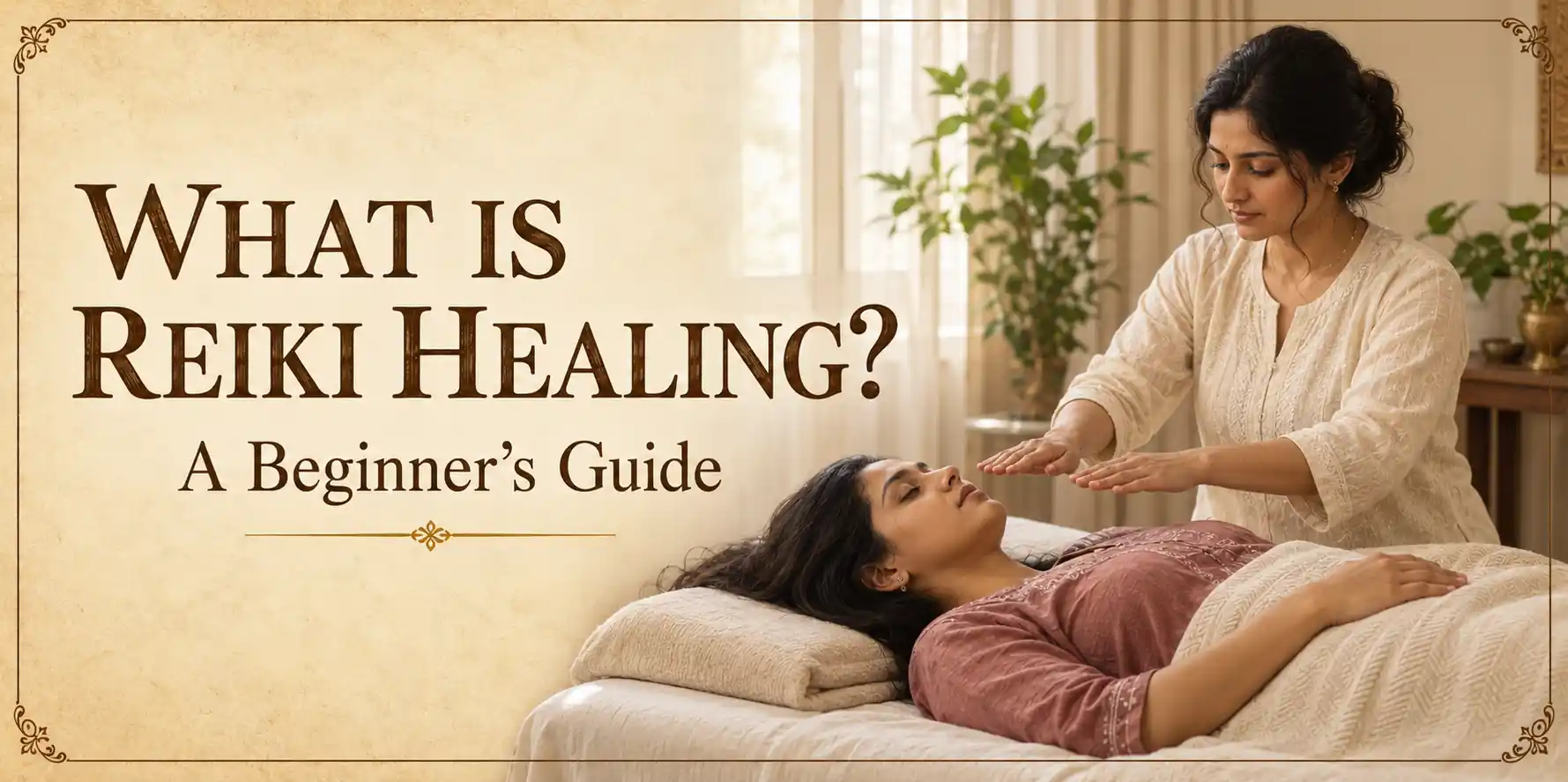
Have you ever seen a person place hands just about a person's body, but not touching them and then the person receiving the energy is calm and relaxed, despite it seeming like nothing was done? You've probably wondered what is going on.
Well, that's Reiki, a Japanese practice in which a practitioner places hands lightly on, or above, your body to support your own healing and calm and this is also referred to as Reiki healing or Reiki therapy. People primarily use it to relax and relieve stress.
This guide answers the questions that people often get curious about and the main one is: can this gentle practice like Reiki really help you feel better, or is it just a comforting belief and is it worth your time? To answer this question, we will look at what Reiki is, how it works, what the research says and how you can learn if you are interested
What Is Reiki? Meaning and Definition
Reiki is a Japanese practice of hands-on or hands-above healing and the word Reiki means universal life energy.
|
Part of word |
Usual meaning |
|
rei |
Universal, or spirit |
|
ki |
Life energy |
|
Reiki |
Universal life energy |
According to the practitioners, the life energy flows through every living being and when it's low or blocked a person may feel stressed or unwell. A Reiki practitioner is believed to act as
a channel who helps the energy flow, usually by placing their hands lightly on your body or holding them a little above it, that is why Reiki is also called palm healing or hands-on healing.
Reiki is described as a complementary therapy, meaning that it is used alongside normal medical care and this is how the National Center for Complementary and Integrative Health (NCCIH), a United States government health agency, describes it too.
Here's what Reiki is not:
-
Not massage. The practitioner does not press or move your muscles.
-
Not a religion. People of any belief can learn it or receive it.
-
Not a replacement for a doctor. It is designed to be used alongside medical care.
The belief in a universal life energy is a belief of the tradition and NCCIH says that there is no scientific evidence that this energy field exists.
What Is Reiki Healing? Meaning and Purpose
Reiki healing is simply the term that many people use for Reiki, this is described as a type of energy healing or energy therapy because Reiki healing is based on the belief in a life energy that can be guided.
The word “healing” in Reiki healing means supporting your body and mind to relax and return to balance and it does not mean curing a disease, as WebMD says clearly that Reiki does not cure or remove any health condition by itself.
How Does Reiki Work? The Traditional Explanation
Practitioners say that Reiki works by guiding a universal life energy through their hands, but scientists have not found evidence that this energy exists.
Here's how practitioners explain it, in three simple steps:
-
A universal life energy flows through every living thing.
-
When this energy is blocked, it is believed to show up as stress, pain or illness.
-
The practitioner helps the energy to move by placing their hands on or just above your body, which is said to help you relax and return to balance.
Practitioners say that they act as a channel and do not give their own energy. The techniques that you may hear about are centering (a calm start), clearing (removing blocked energy), beaming (sending Reiki without touch) and smoothing the aura (moving the hands over the body without touching it). Here's the truth: this is what the explanation inside the tradition says and many people continue to feel relaxed during Reiki, which the research section below looks at.
🔒 Unlock - Free Reiki Complete Syllabus + Free Intro Demo Class ➔
Reiki Therapy and Reiki Treatment: What Do the Words Mean?
Reiki therapy and Reiki treatment are different names for Reiki and a Reiki treatment usually refers to one session and not a proper medical treatment.
|
Word you see |
What it usually means |
|
Reiki healing |
The practice, described as a type of energy healing |
|
Reiki therapy |
The same practice, described as a complementary therapy |
|
Reiki treatment |
One Reiki session, which usually takes 60 to 90 minutes |
Reiki History: Origin, Mikao Usui and How Reiki Spread
Where did Reiki come from? It began in Japan in the early 1900s with Mikao Usui, who developed the form called Usui Reiki, which is the most widely practised form today.
|
Period |
What happened |
|
Early 1900s |
Mikao Usui develops Usui Reiki in Japan and many sources give 1922 as the year |
|
After Usui |
He trains students as Reiki masters and one of them, Chujiro Hayashi, opens a Reiki clinic in Tokyo |
|
Later |
Hawayo Takata teaches Reiki in Hawaii and the United States and it spreads to other countries |
|
Today |
Some hospitals and hospices offer Reiki as a comfort for patients |
According to the story that Reiki teachers tell, Usui fasted and meditated for 21 days on Mount Kurama and came away with the method that he later taught. This account comes from the tradition itself and cannot be verified through independent records.
What Happens in a Reiki Session?
Imagine you’ve booked a Reiki session for tomorrow. What will happen?
-
You’ll lie on a table or sit in a comfortable chair, fully dressed, in a private room.
-
The practitioner will place their hands lightly on, or just above, various parts of your head, arms, legs and torso.
-
Each position is held for around three minutes.
-
If you have an injury such as a burn, the practitioner will keep their hands just above the affected area and avoid touching it.
A full session can last anywhere between 60 and 90 minutes. You may feel warmth or tingling, or a deep relaxation, or even fall asleep, or you may feel nothing at all. Before your session, make sure to mention to the practitioner any health conditions, pregnancy or scarring so they can modify the session for you.
🔒 Unlock - Free Reiki Complete Syllabus + Free Intro Demo Class ➔
Who Is a Reiki Practitioner?
A Reiki practitioner is trained in Reiki and gives Reiki sessions and as this area is not standardised, it is well worth asking them about their training.
WebMD states that a practitioner can be anyone trained in Reiki and that there is no national certifying exam in the United States and Medical News Today points out that few regulations govern this field. Before booking a session it is well worth asking:
-
How and where were you trained in Reiki?
-
How long have you been giving sessions?
-
How do you modify a session for someone with a health condition?
The Five Reiki Principles
Reiki also has five simple rules for living life daily, which begin with the phrase "just for today":
-
Just for Today, I Will Not Be Angry
-
Just for Today, I Will Not Worry
-
Just for Today, I Will Be Grateful
-
Just for Today, I Will Do My Work Honestly
-
Just for Today, I Will Be Kind to All Living Creatures Including Myself
They are just life rules, not a treatment you don't need an attunement to these techniques. Our article about 5 Reiki principles (Gokai) fully describes each principle with examples
Reiki Levels Explained: Level 1, Level 2, Master and Grand Master
Reiki is taught in three traditional degrees and the All India Institute of Occult Science teaches five levels of Reiki from Level 1 to the Grand Master.
Consider Reiki levels like classes in school, with every lesson adding a new layer of skills for you to learn. Traditionally, the first degree of Reiki is for healing yourself and others through touch, the second lets you heal at a distance and the third, also called the master level, is for teaching Reiki and giving attunements. Some schools split the third degree into two parts and some add a level above it, which makes the names and titles vary from institute to institute.
All India Institute of Occult Science Reiki Levels
The All India Institute of Occult Science teaches Reiki in 5 levels and the table below lists what you learn in each level according to our Reiki course page at the institute.
|
Level |
What you learn |
Listed duration |
|
Reiki Level 1 |
The basics of Reiki energy healing, hand placements, self-healing and healing others and the first attunement |
1 day (3 to 4 hours) |
|
Reiki Level 2 |
Distance healing and the three sacred symbols and the second attunement |
1 day (3 to 4 hours) |
|
Reiki Level 3 (A) |
Master symbol, advanced healing and personal techniques and the third attunement |
1 day (3 to 4 hours) |
|
Reiki Level 3 (B) |
How to teach Reiki and attune others to the first and second degree as a Reiki teacher |
2 days (3 to 4 hours) |
|
Reiki Grand Master |
All Reiki symbols, advanced healing techniques and teaching at every level |
2 days |
Each level involves live online sessions with theory and practical, the listed eligibility is 10th pass and the institute mentions that teaching might take more time than mentioned, as the focus is more on learning rather than finishing the syllabus. A Reiki practitioner typically completes the Level 1 and Level 2 of Reiki and a Reiki master has completed the Level 3 and the University of Minnesota's Taking Charge website mentions that only Reiki masters can teach Reiki to others. As class hours vary from institute to institute, it is best to ask any teacher about the number of hours covered in each level and to understand the difference between Level 1 and Level 2, read our article on Reiki Level 1 vs Level 2.
Reiki Attunement and Symbols: Meaning and Uses
Here's where Reiki is different from most skills. An attunement is a ritual in which a Reiki teacher is believed to pass on to the student the ability to practise Reiki and it is given at each level. Students describe it as calm and some report feeling tingling or tiredness afterwards, while others feel nothing and as a belief of the tradition, it is described here as what teachers and students say and not as a proven fact.
Reiki symbols are usually taught from the second level onwards and three are commonly taught at that level.
|
Symbol |
Commonly described as |
|
Cho Ku Rei |
The power symbol |
|
Sei He Ki |
The symbol for emotional and mental balance |
|
Hon Sha Ze Sho Nen |
The symbol for distance healing |
Schools spell and translate these names in different ways, so it is best to learn them in the classroom with a trained teacher. At AII India Institute of Occult Science, Level 2 includes the three sacred symbols and the master symbol is taught at Level 3 (A).
🔒 Unlock - Free Reiki Complete Syllabus + Free Intro Demo Class ➔
How to Practise Reiki on Yourself
Can you do Reiki on yourself? Yes and it is the part of Reiki that most beginners learn first: a self-treatment taught in Level 1 classes with a Reiki instructor. Students are shown how to sit or lie down comfortably and place their hands lightly on various points on the head, arms, legs and torso, holding each position for a few minutes. The Taking Charge website says daily hands-on self-treatment is the basis of Reiki practice, and WebMD notes that a practitioner may use up to 15 hand positions, so the sequence may vary from teacher to teacher.
What Are the Potential Benefits of Reiki?
People use Reiki primarily to relax, relieve stress and provide comfort, but its benefits have not been proven by strong research.
Cleveland Clinic lists the things that fans of the practice say it can help with:
-
Better sleep
-
Less anxiety
-
A better mood
-
Less pain
-
More energy
Medical News Today adds that the gentle nature of Reiki may be soothing for people who feel overwhelmed during medical treatment. But these are things that people say, and Cleveland Clinic itself notes that the benefits have not been proven by rigorous research, so let's look at what the research says.
Is Reiki Scientifically Proven? What Research Says
No, Reiki has not been proven to treat or cure any health condition, and the research into it is stilll weak.
|
Source |
What it says |
|
NCCIH, a US government health agency |
Reiki has not been proven effective for any health condition: most trials were low quality and yielded inconsistent results, and there is no scientific basis for the existence of the energy field, and no negative side effects have been reported |
|
Only three trials were found, and their results were too weak to say anything. |
|
|
Reported positive results regarding the impact on the quality of life, but noted that there is a need for high-quality research |
So, Reiki may help some people relax, but more in-depth research is yet to be done.
Because the question remains: why do people feel calmer after a Reiki session? Part of the reason may be the setting, because lying still in a quiet room for an hour with someone who gives you their full attention helps the body and mind settle, and a doctor quoted by Cleveland Clinic makes the same point.
Is Reiki Safe? Side Effects and Risks
Reiki itself is considered safe, and the real risk is using it as a replacement for medical care.
NCCIH says that no harmful effects have been shown, and Cleveland Clinic says that using Reiki as one tool for caring for your body and mind is the safe route, and using it as the sole treatment is not. Please speak to a doctor first if any of these apply to you:
-
You have a diagnosed condition, or a symptom that has not been explained.
-
You are pregnant, or you have scarring or an injury on the body.
-
You are thinking about reducing or stopping a medicine or a treatment.
Never stop a treatment because of Reiki.
Reiki, Chakras, Prana and Qi: Key Differences
If you have attended a Reiki class in India, you may have heard about chakras too. Here's how the ideas connect:
-
Ki (Reiki): a universal life energy, from Japan.
-
Prana and chakras: a life-giving energy said to flow through energy centres, from Indian philosophy.
-
Qi: a vital life force, from traditional Chinese medicine.
Cleveland Clinic points out that these are similar ideas from different cultures, which is why they often appear together in a class and the All India Institute of Occult science Reiki course lists chakra balancing and chakra therapy among its topics. Chakras belong to a belief system and have not been measured by medical science. To see how Reiki differs from another energy practice popular in India, read our comparison of Reiki and Pranic Healing.
Who Can Learn Reiki? Requirements for Beginners
Almost anyone can learn Reiki, and no medical or scientific background is needed.
The University of Minnesota's Taking Charge site says that people of any age or state of health can learn Reiki as a form of self-care, and at All India Institute of Occult Science the listed eligibility is 10th pass. Many people begin with Level 1 for themselves and their family, and those who wish to teach or work as a practitioner continue through the higher levels, with roles such as freelance Reiki practitioner, Reiki teacher, meditation instructor, holistic wellness consultant and stress management coach listed on the course page. If you're just starting out, our guide on how to learn Reiki for beginners explains the different ways to learn.
Learn Reiki Online at AIl India Institute of Occult Science
If you wish to learn Reiki with a teacher, we, the All India Institute of Occult Science, provide an online Reiki course with live classes. The institute is an ISO certified and government-recognised institute that has been teaching Reiki for 22 years now, and our Reiki classes are conducted by expert tutors.
|
Details |
Information |
|
Classes |
Live online classes on the institute's mobile app (Android and iOS) and web app |
|
Batch size |
10 to 15 students, to provide individual attention to each student |
|
Missed a class? |
The recording of the class will be available within four hours so that you can revise at your convenience |
|
Doubts |
Ask in the class or the course discussion section, where you can also interact with your faculty and batch |
|
Certificate |
Issued by the institute on successful completion of the course and examination |
You can read the full syllabus PDF before you decide, or book a free live demo class, where the head faculty teaches a session and the team calls you to confirm your seat.
How to Choose a Reiki Course: 5 Things to Check
Reiki is not a standardised practice, so the title Reiki master is no guarantee that a teacher has the training you want, and Taking Charge site says that a credible teacher will welcome your questions. These five checks can help you weigh up courses, including ours.
|
Check |
What to ask |
|
The teacher's training and experience |
Who trained them, for how long and how many students they taught |
|
The syllabus and the hours |
What each level includes, and how many hours of classes and practice each level has |
|
The certificate |
Who issues it, what it says, and if the institute can show their registration and certification documents |
|
The batch size and practice time |
How many students are there in a batch for one teacher because a small batch means more questions can be asked |
|
The fee and the support after class |
What is included in the fee, if they give recordings, and if you can ask questions after the course ends |
The Final Takeaway
Let us go back to the question we began with that is- can a gentle practice such as Reiki truly make a difference, and is it worth your time?
-
Many people find Reiki sessions relaxing and soothing and that's enough to give it a try.
-
Research has no evidence that Reiki can treat any health condition. So it should always be used with medical care.
-
If you want to learn it, ask all these questions about the teacher, the hours and the certificate before paying.
So, it depends on what you are looking for when considering a Reiki session. Something calming and relaxing? Reiki is certainly worth trying. Do you want treatments that can help with a particular illness? Consult with a doctor first. To test if the mode of instruction is right for your liking, you can always visit the Reiki course page and book a demo class.