Written by Jyoti Chauhan, Content Writer · Reviewed by Gurudev Shrie Kashyap, Chairman & Founder, All India Institute of Occult Science · Published 19 Nov 2026
Key Takeaways
- Mulank and bhagyank are the two core numbers in Indian numerology: the mulank (birth or psychic number) comes from your day of birth, and the bhagyank (destiny number) from your full date of birth.
- Both are reduced to a single digit from 1 to 9; some numerologists keep 11, 22 and 33 as master numbers for the bhagyank.
- The mulank describes how you see yourself and your natural personality; the bhagyank describes your life direction and the opportunities you meet.
- Example: sample DOB 28-03-1990 gives mulank 1 and bhagyank 5.
- Reading the two together, as friendly, neutral or contrasting, gives a fuller picture than either number alone.
Ask a numerologist about yourself and the first thing they will do is write your date of birth on a piece of paper and start adding. Within seconds, they will tell you two numbers: your mulank and your bhagyank.
These two numbers are the foundation of Indian numerology (ank jyotish). Almost everything else, from name corrections to compatibility, is read in relation to them.
This guide shows you how to calculate both, with two worked examples, explains what each number means from 1 to 9, and shows how to read them together. For a broader introduction, see our complete guide to numerology.
What Are Mulank and Bhagyank?
Mulank (mool = root, ank = number) is your birth number, also called the psychic number. It is calculated from the day of the month you were born and describes your inner nature: how you think, react and see yourself.
Bhagyank (bhagya = fortune or destiny) is your destiny number, calculated from your full date of birth. It describes the broader direction of your life, the lessons you meet and the kind of opportunities that come your way. In Western numerology, the same calculation is called the life path number; our page on the life path number covers that system in detail.
Each number from 1 to 9 is linked with a graha, an idea shared by Indian practice and writers such as Cheiro, whose Book of Numbers (1926) popularised it internationally.
How to Calculate Mulank and Bhagyank

Step 1: Calculate the mulank
Take the day of your birth (1 to 31) and add its digits until you reach a single digit.
- Born on the 9th: mulank 9.
- Born on the 23rd: 2 + 3 = 5.
- Born on the 28th: 2 + 8 = 10, then 1 + 0 = 1.
Step 2: Calculate the bhagyank
Write your full date of birth as DD-MM-YYYY and add every digit. Reduce the total to a single digit. If the total is 11, 22 or 33 before reducing, some numerologists note it as a master number; our guide to master numbers explains when they are used.
Worked example 1 (sample DOB: 28-03-1990)
- Mulank: 2 + 8 = 10, then 1 + 0 = 1
- Bhagyank: 2 + 8 + 0 + 3 + 1 + 9 + 9 + 0 = 32, then 3 + 2 = 5
- Reading: a self-driven, independent nature (1, Sun) on a life path of change, communication and variety (5, Mercury). The Sun and Mercury are traditional friends, so the two numbers support each other.
Worked example 2 (sample DOB: 17-11-1985)
- Mulank: 1 + 7 = 8
- Bhagyank: 1 + 7 + 1 + 1 + 1 + 9 + 8 + 5 = 33, a master number for some schools, which reduces to 3 + 3 = 6
- Reading: a patient, hardworking nature (8, Saturn) on a path of care, family and responsibility (6, Venus). Saturn and Venus are traditional friends, so the combination is read as steady and supportive.
Want to skip the arithmetic? The free numerology calculator gives both numbers instantly.
Mulank vs Bhagyank: The Difference
| Mulank | Bhagyank | |
|---|---|---|
| Also called | Birth number, psychic number | Destiny number, life path number |
| Calculated from | Day of birth only | Full date of birth |
| Describes | Inner nature, instincts, self-image | Life direction, lessons, opportunities |
| Felt most | In daily behaviour and early life | Over the long arc of life, often more after the mid-thirties |
| Used for | Personality, lucky dates, compatibility | Career direction, life themes, name harmony |
Many numerologists say the mulank is felt strongly in the first half of life and the bhagyank grows more prominent later. This is a traditional observation, not a fixed rule.
Numbers 1 to 9 as Mulank and Bhagyank

| No. | Planet | As mulank (nature) | As bhagyank (life direction) |
|---|---|---|---|
| 1 | Sun | Independent, confident, a natural initiator | Leadership roles, building something of your own |
| 2 | Moon | Sensitive, intuitive, cooperative | Partnerships, care, diplomacy, creative work |
| 3 | Jupiter | Optimistic, wise, expressive | Teaching, guidance, knowledge and advice |
| 4 | Rahu | Original, unconventional, systematic | Reform, technology, new methods; sudden turns |
| 5 | Mercury | Quick, curious, communicative | Business, travel, media and variety |
| 6 | Venus | Warm, artistic, harmony-seeking | Family, beauty, the arts and service |
| 7 | Ketu | Introspective, analytical, spiritual | Research, philosophy, healing and inner growth |
| 8 | Saturn | Patient, disciplined, serious | Slow, steady success through hard work and structure |
| 9 | Mars | Energetic, brave, compassionate | Courage, protection, humanitarian work |
For a fuller description of each number, read our guide on the meaning of numbers 1 to 9.
How Mulank and Bhagyank Work Together
Numerologists usually read the pair in one of three ways, based on the traditional friendships between their planets.
- Same number: for example mulank 3 and bhagyank 3. The trait is read as very strong, a clear, focused personality. The flip side can be a lack of balance, so the missing qualities are worth developing.
- Friendly numbers: for example 1 and 2, or 5 and 6. Nature and life path support each other, and things tend to feel aligned.
- Contrasting numbers: for example 1 and 8 (Sun and Saturn). The person may feel a pull between quick self-expression and slow, patient effort. Learning to use both qualities at the right time becomes the life lesson.
Your lucky numbers are drawn from this pair too; our guide on lucky number by date of birth shows how.
Mulank and Bhagyank in Compatibility
Numerologists also compare two people's numbers, for friendships, business partnerships and marriage. The usual method is simple:
- Compare the mulanks: this shows how two personalities feel day to day. Friendly mulanks (for example 2 and 1) usually get along easily.
- Compare the bhagyanks: this shows whether two life directions move the same way. Matching or friendly bhagyanks suggest shared goals.
- Cross-check: one person's mulank against the other's bhagyank, and the reverse. Friendly cross-links are read as mutual support.
Contrasting numbers do not mean two people should not be together. They point to differences worth understanding, such as one partner who decides quickly (1) and one who prefers patient planning (8). Many numerologists say such pairs, once they respect each other's pace, balance each other well.
For marriage, families in India often also look at kundli matching. Numerology compatibility is a lighter, complementary view, best used for reflection rather than as a deciding test.
Seeing the Full Picture: The Lo Shu Grid
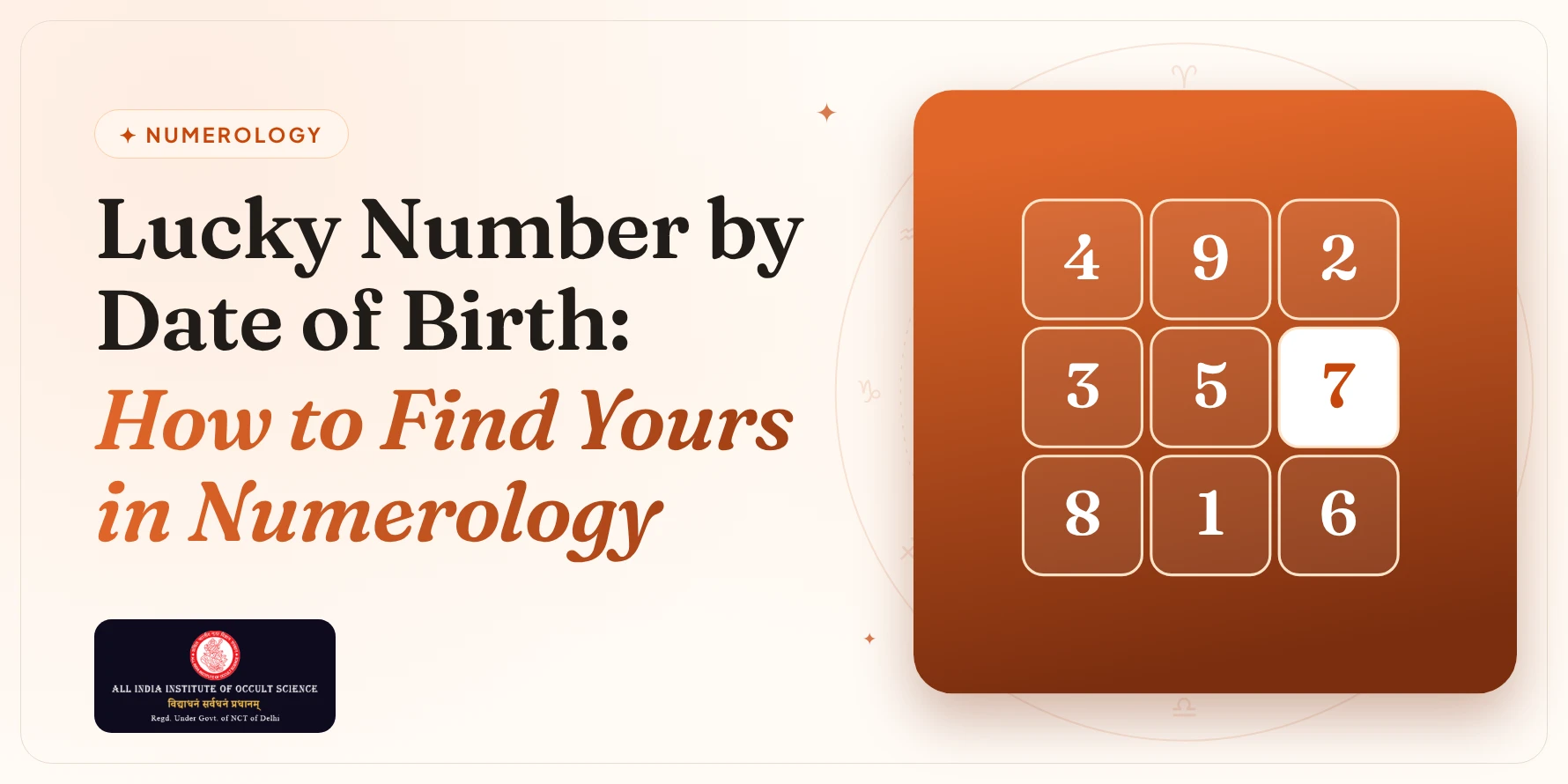
Mulank and bhagyank tell you two numbers. The Lo Shu grid places every digit of your date of birth on a 3×3 magic square, showing which numbers repeat and which are missing. Numerologists read the grid together with the mulank and bhagyank for a much richer picture. Try it with the free Lo Shu grid calculator.
Common Mistakes
- Using only the year or month: the mulank uses the day only; the bhagyank uses every digit.
- Forgetting to reduce: 28 is not a mulank; reduce it to 1.
- Using a registered rather than actual birth date: numerology uses the actual date of birth.
- Treating a contrasting pair as "bad": contrast describes a lesson, not a problem.
- Changing your name too quickly: name corrections should be considered carefully with a trained numerologist, not based on one number.
What Mulank and Bhagyank Can and Cannot Tell You
| They can | They cannot |
|---|---|
| Describe personality tendencies and life themes, as tradition reads them | Predict specific events, health or wealth |
| Offer a starting point for self-reflection and career thinking | Decide your career or marriage for you |
| Help compare harmony between people | Prove that a relationship will succeed or fail |
How to Learn Numerology Properly
Calculating two numbers takes a minute; reading them well alongside the name number, Lo Shu grid, personal year and compatibility takes practice. The Institute's numerology course runs as a Diploma in Numerology (about 2 months) and a Master in Numerology (about 4 months), taught live online in small batches.
Conclusion
Your mulank is the number of your nature, from your birth day; your bhagyank is the number of your path, from your full date of birth. Read together, they describe who you are and where life tends to lead, as tradition sees it. To see both numbers, plus your name number, in seconds, use the free numerology calculator.
This article shares traditional numerology knowledge for educational purposes. It is not a substitute for professional medical, legal or financial advice. Please read our disclaimer.