Written by Mahi Kashyap, CEO, All India Institute of Occult Science · Published 18 Nov 2026
Key Takeaways
- To become a tarot card reader, you need 4 things: knowledge of all 78 cards, regular practice, a structured course or mentor, and clear ethics for reading for others.
- Most learners can read confidently for themselves within 2-3 months and for others after 6-12 months of steady practice.
- No law in India requires a licence to read tarot, but a certificate from a structured course shows clients you trained properly.
- The All India Institute of Occult Science offers a Diploma (about 2 months) and a Master (about 4 months) in Tarot / Card Reading, eligibility 10th pass.
- Good readers never predict death, illness or legal outcomes, and never sell fear-based remedies.
Maybe it started with a reading at a friend's wedding, or a deck you bought on a whim and could not stop shuffling. Now you are wondering whether you could do this properly, perhaps even professionally.
Tarot reading has grown a great deal in India over the past decade, through Instagram, YouTube and online consultations. Alongside the interest, there is plenty of confusion: Do you need to be "gifted"? Is a certificate necessary? How do readers actually find clients?
This guide answers those questions honestly. It covers the skills you need, a practice routine, certification options, how to start reading for others, the ethics that build trust, and common mistakes to avoid. If you want to start with the cards themselves, our complete guide to tarot cards is the best first stop.
What Does a Tarot Card Reader Do?
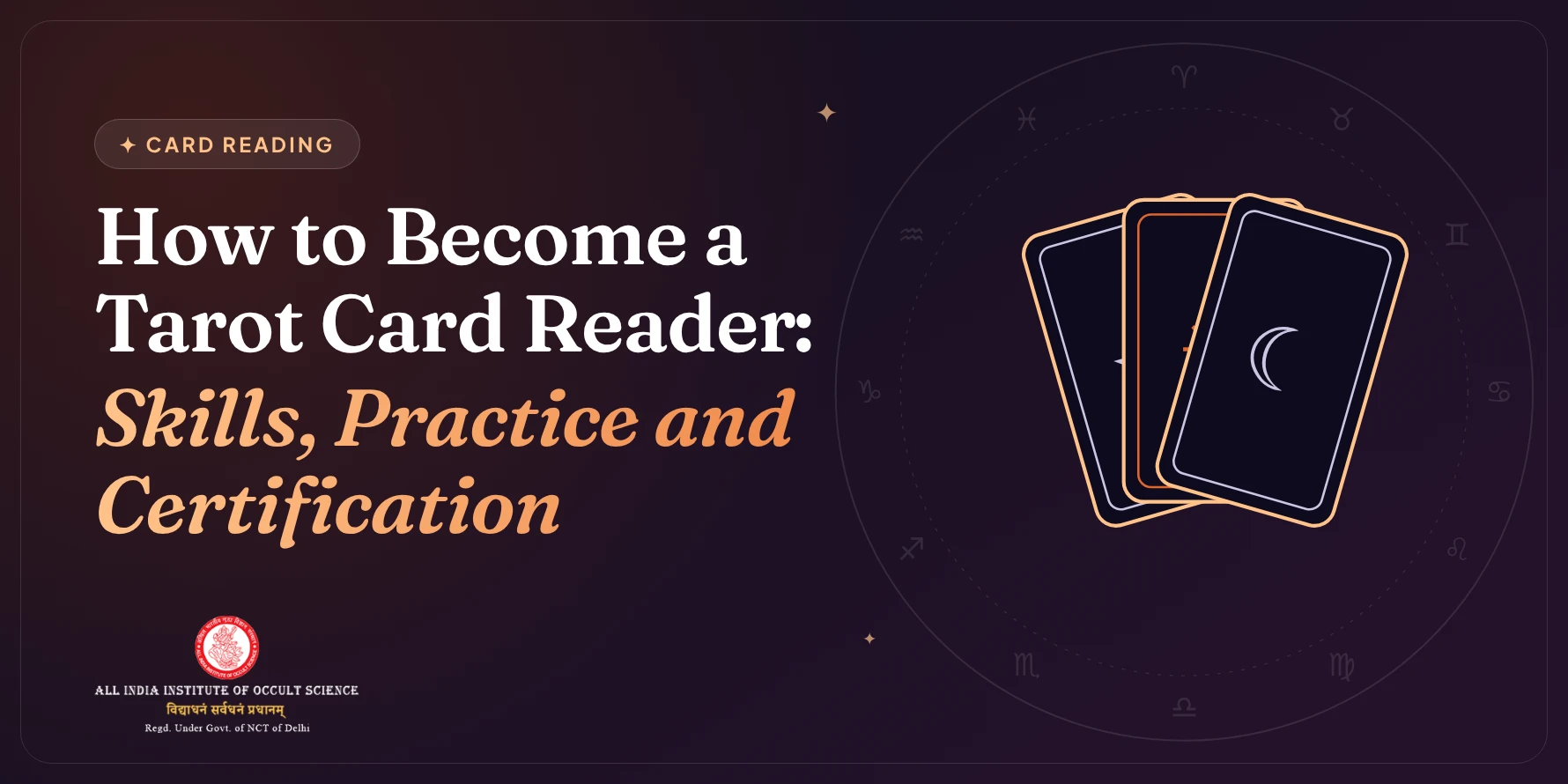
A tarot card reader uses a deck of 78 cards to help a person reflect on a question or situation. The reader shuffles, lays out cards in a pattern called a spread, and interprets the cards' traditional meanings in relation to the question and to each other.
Tarot cards began in fifteenth-century Italy as playing cards, and were later adopted for divination in eighteenth-century France, as Britannica's history of tarot explains. Most modern readers use the Rider-Waite-Smith deck (1909) or decks based on it.
In practice, a good reading feels like a structured conversation. The cards provide images and themes; the reader helps the client see their situation more clearly and think about options. A reader is not a fortune machine, and the best ones say so.
Skills You Need to Become a Tarot Card Reader

1. Card knowledge
You need to know all 78 cards: the 22 Major Arcana, which describe big life themes, and the 56 Minor Arcana in four suits (Cups, Wands, Swords and Pentacles), which describe everyday matters. Learn each card's upright and reversed meanings, its imagery and its number and suit symbolism.
2. Spread reading
Cards change meaning according to their position. You need to be comfortable with common spreads, from a simple three-card past-present-future layout to the ten-card Celtic Cross.
3. Synthesis
This is the real skill: combining several cards into one coherent story instead of reciting separate meanings. It comes only with practice.
4. Listening and communication
Clients often arrive anxious. A reader needs to listen, ask clarifying questions, and explain the cards in calm, simple language.
5. Judgement and ethics
Knowing what not to say is as important as knowing the cards. More on this below.
Choosing Your First Deck
Your first deck matters more than people think, because you will spend months with its images. Look for these qualities:
- Fully illustrated Minor Arcana: scenes on every card, not just suit symbols, make meanings easier to remember.
- Rider-Waite-Smith structure: most books and courses use it, so what you learn transfers easily.
- A comfortable card size: cards that are easy to shuffle in your hands.
- Images you enjoy: you are more likely to practise daily with a deck you like looking at.
Once you know one deck well, exploring other artistic decks becomes a pleasure rather than a confusion.
Step-by-Step: How to Become a Tarot Card Reader
Step 1: Choose one deck and learn it well
Start with a Rider-Waite-Smith style deck. Its pictures carry the meanings, which makes learning easier. Avoid collecting many decks at first.
Step 2: Study one card a day
Draw a card each morning, write its meaning in your own words, and note in the evening how its theme showed up in your day. In 78 days you will have met every card personally.
Step 3: Practise small spreads
Move to three-card spreads for your own questions. Write the question, the cards and your interpretation in a journal.
Step 4: Learn with structure
A course or mentor gives you a tested syllabus, corrects your interpretations and answers doubts. This is where most self-learners save months.
Step 5: Read for friends and family (with permission)
Offer free practice readings to people you trust and ask for honest feedback on clarity and accuracy.
Step 6: Get certified
Complete a course with an assessment. It confirms your training and gives clients confidence.
Step 7: Start reading professionally, slowly
Begin with a few clients a week, keep notes, and continue learning. Experience builds your reputation more than anything else.
A 90-Day Practice Plan (Sample)
| Weeks | Focus | Daily practice (20-30 min) |
|---|---|---|
| 1-3 | Major Arcana (22 cards) | One card a day, journal its image and meaning |
| 4-5 | Cups and Wands | Two cards a day; compare cards of the same number |
| 6-7 | Swords and Pentacles | Two cards a day; note how the suit changes the tone |
| 8-9 | Court cards and reversals | Practise reading reversed cards with one method |
| 10-11 | Three-card and five-card spreads | One spread a day on your own questions |
| 12-13 | Practice readings for others | Two or three readings a week, with feedback |
Keep everything in one journal. Looking back after three months shows you how much your interpretations have grown.
Building Intuition Alongside Knowledge
Many people believe tarot readers are simply "gifted". In practice, what looks like a gift is usually knowledge plus attention. Readers develop intuition by noticing which part of a card's image catches their eye, how the cards relate visually in a spread, and how the client responds as they speak. Short meditation before a reading, a quiet space and a clear question all help. Intuition grows on top of solid card knowledge; it does not replace it.
How to Run a Reading Session
- Before: agree on the time, the format (online or in person) and your guidelines, such as no health or legal predictions.
- Opening: help the client frame an open question, for example "What should I keep in mind about this job change?" rather than "Will I get the job?"
- The spread: choose one that fits the question, and explain each position as you lay the cards.
- Interpretation: tell the story of the cards together, check in with the client, and leave room for their own insights.
- Closing: summarise two or three practical takeaways, and avoid leaving the client anxious.
Tarot and Other Occult Sciences
Tarot is often learnt alongside other subjects. Each one answers a different kind of question, so many practitioners combine them thoughtfully.
| Subject | Works from | Best suited to |
|---|---|---|
| Tarot | Cards drawn for a question | Reflection on a current situation and options |
| Astrology | Exact birth date, time and place | Life themes and timing over years |
| Numerology | Date of birth and name | Personality patterns and personal cycles |
How Long Does It Take?

| Stage | Typical time | What you can do |
|---|---|---|
| Learning the 78 cards | 1-3 months | Recognise cards and their core meanings |
| Reading for yourself | 2-3 months | Interpret three-card and five-card spreads |
| Structured course | 2-4 months | Learn spreads, synthesis, ethics; pass an assessment |
| Practice readings for others | 3-6 months | Build confidence and feedback |
| Professional readings | 6-12 months onwards | Read for clients, keep refining |
These are typical ranges, not promises. Some people move faster; others prefer to read only for themselves, which is equally valid.
Tarot Certification: Do You Need It?
In India, no law requires a licence or certificate to read tarot. Certification matters for other reasons:
- Structured learning: a good course covers all 78 cards, spreads, synthesis and ethics, so you do not miss foundations.
- Assessment: an exam shows you can actually apply what you learnt.
- Client trust: many clients, especially online, look for a reader's training before booking.
- Community: classmates and teachers become your practice partners and referral network.
When choosing a course, look for live classes where you can ask questions, a clear syllabus, recordings for revision, practical reading sessions and a certificate that is earned through assessment, not just attendance.
Learning Tarot Online
Yes, tarot can be learnt well online. Live online classes let you see the teacher's spreads on screen, ask questions in real time and practise with classmates in other cities or countries. Recordings help you revise difficult cards. The main thing to avoid is purely pre-recorded content with no feedback, because synthesis is learnt through correction.
How Tarot Readers Find Their First Clients
Building a practice takes time and patience. Approaches readers commonly use:
- Word of mouth: friends and family who received good practice readings are your first referrals.
- Social media: sharing a daily card, short educational posts or "pick a card" videos, with clear disclaimers.
- A simple booking page: what you offer, how long a session lasts and your ethical guidelines.
- Events and workshops: wellness fairs, cafés and community events.
- Combining skills: some readers also study numerology or astrology to offer fuller consultations. Our guide on how to become an astrologer covers that path.
Earnings vary widely with skill, reputation, location and the time you invest. Treat it as a practice you grow gradually, not a guaranteed income.
Ethics Every Tarot Reader Should Follow

- No predictions of death, serious illness or pregnancy. Refer health questions to a doctor.
- No legal or financial verdicts. Suggest a lawyer or financial adviser where needed.
- No fear selling. Never tell a client they are cursed or must buy a remedy to be safe.
- Respect privacy. Keep readings confidential, and do not read about third parties without good reason.
- Empower, don't create dependence. Encourage clients to make their own decisions, and avoid daily readings for the same question.
- Know your limits. If a client seems in crisis, gently suggest professional help.
Common Mistakes Beginners Make
- Memorising keywords only: keywords help, but readings need images, context and story.
- Reading too many cards: big spreads confuse beginners; three cards are enough to learn synthesis.
- Asking the same question again and again: it teaches you to distrust the first answer.
- Ignoring reversed cards entirely or fearing them: learn a clear method for reversals and use it consistently.
- Going professional too early: practise on many readings first, with feedback.
A Day in the Life of a Tarot Reader (Typical Routine)
Every reader works differently, but a common routine for someone building a practice looks like this:
- Morning: a short meditation and a daily card for personal reflection.
- Midday: two or three scheduled client sessions of 30-45 minutes each, online or in person.
- Afternoon: session notes, replying to booking enquiries, preparing an educational post.
- Evening: study time, perhaps a new spread or a deeper look at one suit.
Most readers keep a limit on daily sessions. Reading well requires focus, and quality falls when a reader is tired.
What Tarot Can and Cannot Do
| It can | It cannot |
|---|---|
| Offer a structured way to reflect on a situation | Guarantee future events |
| Bring hidden concerns or options into the conversation | Replace medical, legal or financial advice |
| Help clients feel heard and think more clearly | Make decisions on the client's behalf |
How to Learn Tarot With the Institute
The All India Institute of Occult Science's Card Reading course has two levels: the Diploma in Tarot / Card Reading (about 2 months) and the Master in Tarot / Card Reading (about 4 months), both with 10th pass as eligibility and described on the course page as ISO Certified & Govt. Recognised. Classes are live online in batches of 10-15 students, recordings are uploaded within 4 hours, and doubts are answered in class and in the app. You can download the syllabus PDF to see the full topic list.
Conclusion
Becoming a tarot card reader is a path of knowledge, practice and responsibility: learn the 78 cards deeply, practise synthesis on many readings, train with structure, and hold yourself to clear ethics. Take it one stage at a time and your confidence will follow. If you would like to see how the Institute teaches tarot, book a free live demo class and meet a teacher before you decide.
This article shares traditional tarot knowledge for educational purposes. Tarot is not a substitute for professional medical, legal or financial advice. Please read our disclaimer.