Written by Gurudev Shrie Kashyap, Chairman & Founder, All India Institute of Occult Science · Published 17 Nov 2026
Key Takeaways
- Main door Vastu is judged by the exact position of the door along a wall, not only by the direction the house faces.
- Classical Vastu divides each side of a plot into 8 padas (32 in all), each ruled by a deity of the Vastu Purusha Mandala.
- Commonly recommended entrance padas: N3-N5 on the north, E3-E4 on the east, S3-S4 on the south and W3-W4 on the west.
- A south-facing main door is not bad in itself; a door in a well-placed south pada is considered good.
- Most entrance issues can be balanced with low-cost steps: lighting, a clean threshold, colour and a well-kept door, with no demolition.
Whenever a family shows me a new flat, the first question is almost always the same: "Guruji, the main door faces south. Should we drop this one?" Many good homes are rejected because of this one fear.
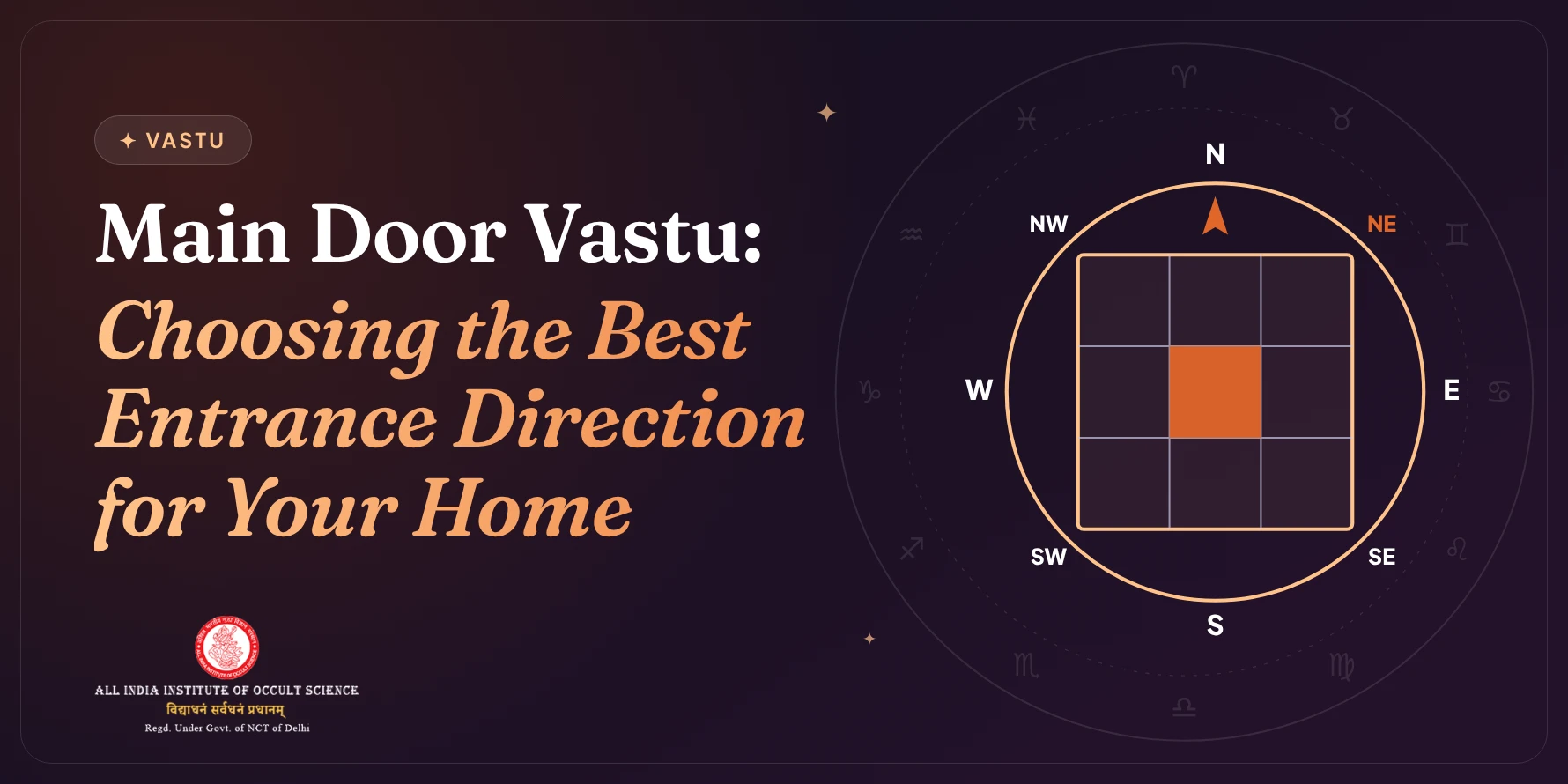
The main entrance is important in Vastu Shastra. It is called the mukha, the mouth of the house, through which people, light and air enter. But classical Vastu is far more precise than "east good, south bad". What matters is where on the wall the door sits.
In this guide I explain how traditional texts judge the entrance, the 32 entrance padas, the truth about south-facing doors, what to keep near the door, and simple corrections that need no construction. For the foundations, see our guide to Vastu Shastra.
Why the Main Door Matters in Vastu
Texts such as the Mayamata and Manasara describe the site as a grid called the Vastu Purusha Mandala, with deities presiding over each part. The outer ring of this grid holds 32 deities, eight on each side. The entrance is placed in the pada of a favourable deity, which is why classical texts discuss the door position in such detail.
Practically, the main door also decides how light and air enter, how the home feels when you walk in, and how rooms flow from the entrance. Good Vastu and good design usually agree.
What Is the Vastu Purusha Mandala?
The Vastu Purusha Mandala is a square grid laid over a plot, imagined as a cosmic being lying with his head in the north-east. The common forms are the 64-square (Manduka) and 81-square (Paramashayika) mandalas. The centre, the Brahmasthan, is kept open; the outer squares are assigned to deities such as Indra, Surya, Yama, Varuna and Soma.
For entrances, the outer ring is what matters. Divide each side of your plot or flat into eight equal parts, and you have the eight padas of that side.
The 32 Entrance Padas Explained

Padas are counted from the corners in a fixed direction: the north side from the north-west, the east side from the north-east, the south side from the south-east and the west side from the south-west.
| Side | Padas (counted from the corner) | Commonly recommended for the door |
|---|---|---|
| North (from NW) | 1 Roga, 2 Naga, 3 Mukhya, 4 Bhallata, 5 Soma, 6 Bhujaga, 7 Aditi, 8 Diti | N3 Mukhya, N4 Bhallata, N5 Soma |
| East (from NE) | 1 Shikhi, 2 Parjanya, 3 Jayanta, 4 Indra, 5 Surya, 6 Satya, 7 Bhrisha, 8 Antariksha | E3 Jayanta, E4 Indra |
| South (from SE) | 1 Anila, 2 Pusha, 3 Vitatha, 4 Grihakshata, 5 Yama, 6 Gandharva, 7 Bhringaraja, 8 Mriga | S3 Vitatha, S4 Grihakshata |
| West (from SW) | 1 Pitru, 2 Dauvarika, 3 Sugriva, 4 Pushpadanta, 5 Varuna, 6 Asura, 7 Shosha, 8 Papayakshma | W3 Sugriva, W4 Pushpadanta |
Schools differ slightly. Some also accept E2 or W5, and some texts use different deity spellings. The principle stays the same: every direction has favourable door positions.
How to Find Your Main Door's Pada Step by Step

Step 1: Find true directions
Stand at the centre of the house with a phone compass, away from metal and electronics, and note north. Take two or three readings.
Step 2: Identify the side the door is on
Which wall of the overall plot or flat holds the main door: north, east, south or west? For flats, use the flat's boundary, not the building's.
Step 3: Divide that side into 8 equal parts
Measure the full length of that side and divide by eight. A 40-foot wall gives padas of 5 feet each.
Step 4: Count from the correct corner
Count from the north-west for a north door, the north-east for an east door, the south-east for a south door and the south-west for a west door.
Step 5: Note which padas the door covers
A door often spans parts of two padas. Note both, and judge by the pada holding most of the door width.
Worked example (sample flat)
A sample flat has a south wall 32 feet long, so each pada is 4 feet. The main door begins 9 feet from the south-east corner and is 3.5 feet wide, so it runs from 9 to 12.5 feet. Counting from the south-east, 8-12 feet is S3 (Vitatha) and 12-16 feet is S4 (Grihakshata). The door sits almost entirely in S3, with a little in S4: both commonly recommended. This south-facing door is well placed.
Main Door Vastu for Flats and Apartments
In apartments, you cannot choose the building's entrance, and the lift lobby may decide where your door goes. Main door Vastu still applies, with a few adjustments:
- Use your flat's boundary: judge the pada from the walls of your own flat, not the whole tower.
- The flat door matters most: the building gate and lift lobby are shared spaces; your own door is your mukha.
- Corridor doors facing each other: common in apartments and not a serious concern. Keep your entrance bright and well kept.
- Doors in a corner: doors placed right at a corner of the flat are usually in the first or eighth pada, which most schools avoid. Lighting, colour and a defined threshold help here.
When buying a flat, it is worth checking two or three units with different door positions. Often, flats on the same floor differ only in where the door falls.
Common Main Door Mistakes
- Judging by the road alone: a house "facing" a road can have its door on another side. Always check the door itself.
- Using a compass near metal: grilles, cars and appliances can throw the reading off by many degrees.
- Ignoring the inside view: a toilet, a dark wall or a staircase directly opposite the door affects the feel of the home more than the pada does.
- Buying remedies before measuring: measure first; most homes need fewer changes than people fear.
Is a South-Facing Main Door Bad? The Myth
This is the most common Vastu fear, and it comes from oversimplification. South is linked with Yama, the deity of dharma and death, so people assume the whole south side is unlucky. But Yama rules only one of the eight south padas (S5). The texts place favourable deities in other south padas, especially S3 and S4.
In my experience, many families live happily and prosperously in south-facing homes with well-placed doors. Equally, a north- or east-facing door can sit in a less favoured pada. Direction alone tells you very little.
Climate matters too. In much of India, a south entrance with a shaded verandah or a good overhang works perfectly well.
What to Keep Near the Main Door
- Light: a well-lit entrance, especially in the evening.
- A clean threshold: no shoe heaps, dustbins or clutter at the door.
- A sturdy, well-kept door: no creaks, broken hinges or peeling paint. The main door is traditionally the largest door in the home.
- Auspicious symbols: a nameplate, toran, rangoli or plants, as your family tradition prefers.
- Open space inside: avoid a wall, staircase or toilet directly facing the door.
Main Door Colour Ideas by Direction
Colour is a gentle way to balance the entrance. These are common suggestions linked with the elements of each direction.
| Door on the | Element linked | Colours often suggested |
|---|---|---|
| North | Water | Light blue, green, white |
| East | Air / sun | Natural wood, light brown, cream |
| South | Fire | Red-brown, orange, terracotta, wood tones |
| West | Space / metal | White, grey, silver, light blue |
Simple Corrections Without Changing the Door
If your door is in a less favoured pada, here are corrections responsible practitioners suggest before anything structural:
- Improve light: a bright lamp at the entrance and good daylight in the hall.
- Define the threshold: a marble or wooden threshold strip and a clean doormat.
- Use the favourable part of the door: in a double door, keep the leaf in the better pada for daily use.
- Balance with colour using the table above.
- Keep the area clean and repaired at all times.
You do not need to buy pyramids, yantras or special strips. If several parts of a home conflict, a proper consultation that looks at the whole plan is wiser than piling up products.
What Main Door Vastu Can and Cannot Do
| It can | It cannot |
|---|---|
| Give a precise, traditional method for placing the entrance | Guarantee wealth, health or harmony |
| Encourage light, ventilation and a welcoming entry | Override building safety rules or society bye-laws |
| Help you judge a home calmly, without fear of one direction | Justify rejecting a good home just because it faces south |
How to Learn Vastu Properly
Reading an entrance correctly needs the whole picture: plot shape, cut corners, slopes, room placement and the mandala. I teach these methods, along with my colleagues, in the All India Institute of Occult Science's Vastu course, in live online classes with practical floor-plan work. You can read more about my background on the founder page, and browse more home guides in our Vastu articles.
Conclusion
Main door Vastu is about precision, not fear. Find the side, divide it into eight padas, count from the right corner and see where your door sits. Every direction, including south, has good positions, and most imbalances can be eased with light, cleanliness and colour. If you would like to study the Vastu Purusha Mandala and learn to read whole homes, explore the Institute's Vastu course, or book a free demo class to see how it is taught.
This article shares traditional Vastu knowledge for educational purposes. It is not a substitute for professional architectural, structural or legal advice. Please read our disclaimer.